When severe weather cuts power or cellular service, a dependable emergency radio can provide alerts, light, and enough backup energy to keep essential devices running. The best emergency radios with crank combine multiple charging methods with clear weather-band reception and practical lighting.
We compared 10 popular models across battery capacity, tuning options, charging flexibility, alert features, and everyday usability to help you choose the right radio for home emergency kits, vehicles, camping, or outages.
Best 10 Emergency Radios with Crank Picks for 2026
Best Overall
Raynic 5000mAh NOAA Weather Radio

- Automatic NOAA alert scanning
- Six charging options and USB output
- LCD display, lights, SOS, and headphone jack
Best For: Families and comprehensive emergency kits
Most Versatile
Midland ER310 Emergency Crank Radio

- NOAA weather scan and alerts
- Multiple power sources with USB
- Flashlight, SOS signal, and dog whistle
Best For: Home preparedness and outdoor activities
Best Compact Pick
RunningSnail 2000mAh Hand Crank Radio

- Only 0.5 pound and compact
- Hand crank, solar, and rechargeable power
- AM/FM/NOAA radio with USB charging
Best For: Camping, hiking, and lightweight emergency kits
Best High-Capacity Kit
10000mAh Solar Emergency Radio
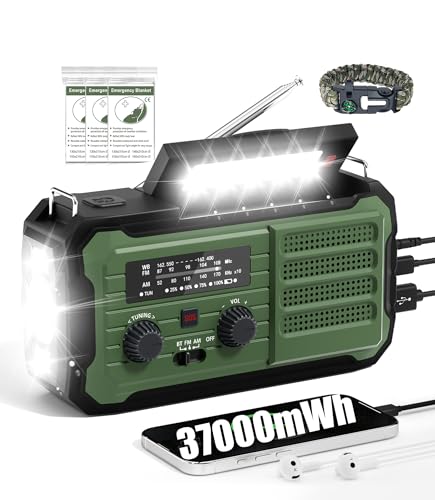
- 10000mAh rechargeable battery
- Automatic scanning across seven NOAA channels
- Includes blanket and survival paracord bracelet
Best For: Preparedness kits and extended outages
Best All-Rounder
RunningSnail 4000mAh Emergency Radio

- 4000mAh battery supports smartphone charging
- Four charging methods, including crank and solar
- NOAA radio, flashlight, and reading lamp
Best For: Home kits, storms, camping, and multipurpose preparedness
Best for Everyday Use

- Lightweight 310-gram portable design
- 2000mAh power bank with crank and solar charging
- Includes flashlight, reading lights, and NOAA alerts
Best For: Portable kits and buyers wanting a warranty-backed option
Best Band Coverage

- AM, FM, shortwave, and NOAA reception
- Multiple power inputs plus hand crank and solar
- USB charging output, lights, and SOS beacon
Best For: Shortwave listeners and versatile home or outdoor preparedness
Best with Extra Features
7400mWh Radio with Built-In Charging Cables
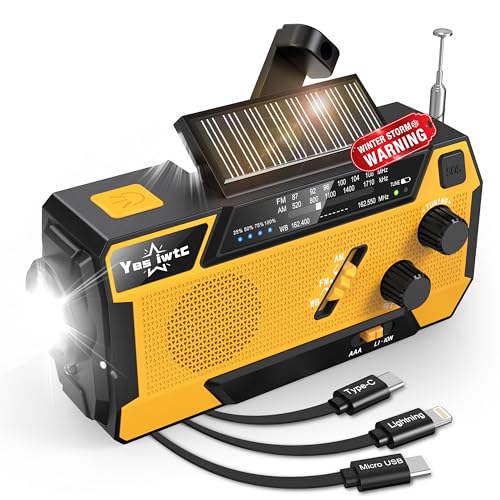
- Three built-in cables: Lightning, USB-C, and Micro USB
- USB-C, solar, hand-crank, and AAA-battery power
- NOAA radio, lights, reading LEDs, and SOS alarm
Best For: Households wanting convenient device charging and flexible backup power
Outdoor-Ready Pick

- 10000mAh battery with emergency USB phone charging
- IPX6 splash resistance and built-in compass
- Manual NOAA, AM/FM, solar, hand-crank, and USB-C support
Best For: Outdoor use, go-bags, camping, and RV emergency supplies
Largest Battery
12000mAh Radio with Large Solar Panel

- 12000mAh battery with phone and USB-device backup charging
- 8500mm² solar panel plus hand crank and Type-C input
- 5W flashlight, 12-LED lamp, and 120dB SOS alarm
Best For: Storm preparedness, outages, camping, and buyers prioritizing capacity
Best Overall – Raynic 5000mAh NOAA Weather Radio
For shoppers comparing emergency radios with crank, the Raynic stands out for its broad reception, automatic NOAA alerts, and unusually flexible charging setup. It combines a 5000mAh rechargeable battery with solar, hand-crank, USB, AC-adapter, and optional AAA-battery power.
Best For: Families and preparedness kits that want automatic alerts, multiple backup power options, and useful lighting.
Pros:
- Automatically scans for NOAA emergency and weather alerts.
- Supports AM, FM, shortwave, and NOAA bands with a large LCD display.
- Offers six charging options plus a USB port for charging compatible devices.
- Includes a bright flashlight, reading lamp, SOS alarm, and headphone jack.
Cons:
- At 1.2 pounds, it is heavier than the most compact options.
- AAA batteries are not included.
- Its IPX3 water resistance is limited to light exposure rather than full waterproofing.
The Raynic is a feature-rich choice when notification capability and charging flexibility matter more than minimum size. Its display, alerts, lights, and audio options make it well suited to home emergency storage or outdoor preparedness.
Most Versatile – Midland ER310 Emergency Crank Radio
The Midland ER310 is a straightforward pick among emergency radios with crank, with multiple power sources, NOAA weather scanning and alerts, and a built-in flashlight. Its practical emergency features make it a useful option for home preparedness and outdoor activities.
Best For: Buyers who want a recognizable emergency radio with weather alerts, multiple power sources, and signaling features.
Pros:
- Includes NOAA weather scan and alert functionality.
- Provides multiple power sources and can support smartphone or tablet charging through USB.
- Built-in flashlight, SOS emergency signaling, and ultrasonic dog whistle add utility.
- Compact 16-ounce design is easy to store or carry.
Cons:
- Supports AM/FM rather than a wider selection of radio bands.
- It is not listed as water resistant.
- Its included battery setup uses six AA batteries, adding bulk for some kits.
The ER310 focuses on core emergency readiness instead of an oversized feature list. It is a sensible choice for users who value weather alerts, signaling tools, and flexible power in a compact package.
Best Compact Pick – RunningSnail 2000mAh Hand Crank Radio
If portability is a priority, the RunningSnail is one of the more convenient emergency radios with crank. It weighs only 0.5 pound, measures 5 by 1.8 by 2.4 inches, and combines AM/FM/NOAA reception with hand-crank, solar, and rechargeable-battery power.
Best For: Campers, hikers, and emergency kits where low weight and compact storage are more important than advanced controls.
Pros:
- Lightweight, compact design is easy to carry or store.
- Three power modes include hand crank, solar, and a built-in 2000mAh battery.
- Supports emergency USB charging for compatible devices.
- Includes a bright LED flashlight and retractable antenna.
Cons:
- Reception is limited to AM, FM, and NOAA bands.
- The 2000mAh battery is smaller than the capacity offered by larger models.
- It has fewer lighting and display features than more feature-heavy radios.
The RunningSnail makes the most sense as a lightweight grab-and-go radio. Its compact build and three power sources cover basic emergency communication and lighting without adding much weight to an evacuation or camping bag.
Best High-Capacity Kit – 10000mAh Solar Emergency Radio
This high-capacity model is designed for shoppers seeking emergency radios with crank plus extra survival gear. Its 10000mAh battery, solar and hand-crank charging, automatic NOAA scanning, flashlight, USB port, and SOS alarm are supplemented by a thermal blanket and a paracord survival bracelet.
Best For: Families, disaster-preparedness kits, and outdoor users who want a radio bundled with basic signaling and survival accessories.
Pros:
- Large 10000mAh rechargeable battery provides extended backup capacity.
- Uses hand-crank, solar, and internal battery charging.
- Automatically scans seven NOAA weather channels for alerts.
- Includes a flashlight, headphone jack, USB port, SOS alarm, thermal blanket, and survival bracelet.
Cons:
- The supplied notes do not specify the radio’s full band lineup or dimensions.
- The added survival accessories may be unnecessary for shoppers seeking only a radio.
- High battery capacity can make it less convenient than a minimalist emergency radio.
This model is best viewed as a preparedness bundle rather than a bare-bones radio. The large battery and automatic alerts support extended outages, while the included blanket and bracelet add useful backup tools for outdoor or disaster scenarios.
Best All-Rounder – RunningSnail 4000mAh Emergency Radio
If you want emergency radios with crank capability for both outages and everyday preparedness, the RunningSnail upgraded model is a versatile option. It combines NOAA, AM, and FM reception with four charging methods, a smartphone-charging battery, and multiple lighting modes.
Best For: Home emergency kits, storm preparation, camping, and users who want strong lighting plus phone-charging support.
Pros:
- 4000mAh battery can charge smartphones and supports USB connectivity.
- Four power options: Micro USB, solar, hand crank, and built-in battery power.
- Includes NOAA weather reception, a 3-mode flashlight, and a motion-sensor reading lamp.
- Water-resistant ABS construction with an external antenna and LCD display.
Cons:
- Its many features may be more than needed for a basic emergency radio.
- The supplied details do not specify the exact phone-charge capacity in real-world use.
The combination of a relatively large battery, weather alerts, and layered lighting makes this a practical centerpiece for a household emergency kit. It is especially useful when you want one device to cover communications, illumination, and limited device charging.
Best for Everyday Use – FosPower A1 NOAA Crank Radio
The FosPower A1 is a compact choice among emergency radios with crank charging, offering NOAA, AM, and FM reception in a lightweight 310-gram design. Its 2000mAh power bank, solar panel, crank lever, and replaceable AAA-battery option provide practical backup flexibility.
Best For: Portable emergency kits, smaller households, and shoppers who value a lightweight radio with a warranty.
Pros:
- 7400mWh power bank can provide emergency power to a phone or small tablet.
- Uses crank, solar, and four AAA batteries as power sources.
- Combines a 1W flashlight with four LED reading lights.
- Includes NOAA emergency broadcasts and a limited lifetime warranty.
Cons:
- AAA batteries are required but are not included.
- Its 2000mAh power bank is smaller than the RunningSnail model in this roundup.
This model is a sensible balance of portability and emergency functionality. The separate reading light and flashlight are useful during outages, while the AAA-battery compartment gives you an additional backup when solar or hand-crank charging is inconvenient.
Best Band Coverage – Kaito KA500 Multi-Band Radio
For shoppers seeking emergency radios with crank charging and broader listening options, the Kaito KA500 stands out with AM, FM, shortwave, and NOAA weather coverage. It also offers several power inputs, a replaceable rechargeable battery pack, lighting, and a USB output for compatible devices.
Best For: Users who want shortwave reception, multiple power choices, and a durable radio for home or outdoor use.
Pros:
- Receives AM, FM, two shortwave bands, and seven pre-programmed NOAA channels.
- Supports hand crank, solar, three AA batteries, USB input, and AC/DC input with an adapter.
- Includes a 5-LED reading lamp, flashlight, and red SOS beacon.
- Telescopic antenna and signal-strength indicator support more precise tuning.
Cons:
- Three AA batteries and the wall power adapter are not included.
- The 8.3-inch length makes it less compact than the FosPower model.
- NOAA weather coverage is specified for the USA and Canada only.
The KA500 is a strong fit when reception flexibility matters more than minimal size. Its shortwave capability and extended antenna add listening range, while the broad selection of power sources helps it remain useful during outages and outdoor activities.
Best with Extra Features – 7400mWh Radio with Built-In Charging Cables
This compact option among emergency radios with crank combines a rechargeable 7400mWh battery with solar, hand-crank, USB-C, and AAA-battery power. Its three built-in charging cables and NOAA, AM, and FM reception make it a practical choice for home emergency kits and outages.
Best For: Households that want built-in phone cables, multiple backup power sources, and emergency lighting in one portable radio.
Pros:
- Includes built-in Lightning, USB-C, and Micro USB cables for charging compatible devices.
- Offers USB-C, hand-crank, solar, and AAA-battery power options.
- Provides NOAA, AM/FM reception, three flashlight brightness modes, six reading LEDs, and an SOS alarm.
Cons:
- The listed 7400mWh capacity is smaller than the batteries in the other models here.
- The analog display may be less convenient than an LCD or LED display.
- Although listed as waterproof, the supplied notes do not specify an IP rating.
Choose this model if convenience is the priority. The permanently attached charging cables reduce the chance of misplacing a cable, while the replaceable AAA option adds another fallback when recharging is difficult.
Outdoor-Ready Pick – Leaton 10000mAh Weather Radio
For shoppers comparing emergency radios with crank, the Leaton emphasizes battery capacity and outdoor portability. It has a 10000mAh internal battery, IPX6 water resistance, solar, hand-crank, and USB-C charging, plus a compass and manual NOAA tuning.
Best For: Camping, RV travel, go-bags, and emergency kits where splash resistance, a compass, and extended backup capacity are useful.
Pros:
- The 10000mAh battery can provide emergency USB phone charging; the notes estimate about 1–1.5 iPhone 14 charges.
- IPX6 water resistance helps protect against water spray and splashing.
- Includes a three-mode flashlight, reading lamp, compass, NOAA/AM/FM reception, and multiple charging methods.
Cons:
- NOAA broadcasts require manual tuning and do not include SAME or automatic alerts.
- The USB output is rated at 5V/1A, so phone charging is intended for emergency use rather than fast charging.
- It is splash-resistant, not intended for heavy rain, immersion, or underwater use.
The Leaton is a sensible middle ground for outdoor preparedness. Its battery and weather-resistant design add practicality, but buyers should be comfortable manually tuning NOAA broadcasts and should not treat the IPX6 rating as full waterproofing.
Largest Battery – 12000mAh Radio with Large Solar Panel
This high-capacity choice among emergency radios with crank pairs a 12000mAh rechargeable battery with an 8500mm² solar panel, hand crank, and Type-C input. It also adds a 5W flashlight, 12-LED reading lamp, 120dB SOS alarm, and IPX6 water resistance for outage and outdoor use.
Best For: Buyers who want the largest stated battery, a bigger solar panel, and brighter emergency lighting for storms, camping, or power outages.
Pros:
- Provides the largest listed battery capacity at 12000mAh and can supply emergency backup charging for phones or small USB devices.
- The 8500mm² solar panel, hand crank, and Type-C input provide several ways to restore power.
- Includes DSP-processed AM/FM/NOAA reception, a 5W flashlight, 12-LED reading lamp, and 120dB SOS alarm.
Cons:
- At 1.6 pounds, it is heavier than the Leaton model listed here.
- The supplied notes state that NOAA stations must be manually tuned and the radio must be powered on.
- IPX6 protection is designed for rain and splashes, not immersion.
This model is the strongest fit when battery size and lighting output matter most. Its larger solar panel and multiple charging methods support preparedness, although its greater weight may be noticeable in a lightweight hiking kit.
How We Picked the Best Emergency Radios with Crank
We focused on features that matter when normal power and communications are unavailable: hand-crank and solar charging, rechargeable battery capacity, NOAA weather-band access, AM/FM reception, flashlight performance, and phone-charging capability. We also considered whether a radio offers useful extras such as shortwave reception, reading lamps, headphone support, multiple lighting modes, or a dedicated emergency alert function.
Capacity claims vary by manufacturer, and real-world runtime depends on brightness, volume, signal conditions, and charging method. A larger battery can provide more reserve power, but it may also make a radio heavier and slower to recharge by hand.
Quick Comparison
| Feature | What to look for | Why it matters |
|---|---|---|
| Power options | Hand crank, solar, USB, and battery backup | Provides flexibility during extended outages |
| Battery capacity | About 2,000mAh to 12,000mAh or higher | Determines how much lighting or device charging is available |
| Radio bands | AM/FM and NOAA; shortwave is an added benefit | Improves access to local and distant broadcasts |
| Lighting | Flashlight plus reading lamp or adjustable modes | Supports navigation and close-up tasks in the dark |
| Phone charging | USB output compatible with your device | Can provide emergency power for calls or messages |
Key Buying Factors for Emergency Radios with Crank
Charging and Battery Capacity
Choose at least two charging methods for resilience. A hand crank is useful immediately but is labor-intensive, while solar charging is convenient yet dependent on direct sunlight. USB charging is the fastest option when grid power or a power bank is available. Larger-capacity models are better for repeated phone charging and longer lighting sessions, but check the listed output and understand that advertised capacity is not the same as usable energy.
Weather Alerts and Reception
NOAA reception is especially important in the United States because it can deliver warnings for storms, floods, and other hazards. Look for a clearly labeled weather band and, if automatic warnings matter to you, verify that the model supports an alert mode rather than simple manual tuning. A telescoping antenna and a stable tuning system can also improve reception.
Lighting and Controls
A bright forward flashlight is useful for walking or signaling, while a reading lamp helps with maps, instructions, and first-aid supplies. Simple controls, visible markings, and a secure hand crank are valuable when the radio must be operated in darkness or during stressful conditions.
Size, Durability, and Accessories
For a home kit, a larger radio with a higher-capacity battery may be worthwhile. For a vehicle or hiking pack, prioritize compact dimensions and low weight. Check for water resistance, a protective design, a wrist strap, headphone support, and included cables. No radio should be treated as a replacement for a dedicated power bank, weather alert device, or two-way emergency communicator.
Who Should Buy Which Emergency Radios with Crank?
For households: Choose a higher-capacity model with solar and USB charging, NOAA alerts, a bright flashlight, and a reading lamp. It will provide the most flexibility during multi-day outages.
For severe-weather preparedness: Prioritize reliable NOAA access, alert functionality, a strong antenna, and controls that are easy to operate quickly.
For camping and travel: Look for a compact, lighter radio with AM/FM, solar charging, a flashlight, and enough battery capacity for occasional phone top-ups.
For budget backup kits: A simpler hand-crank radio with NOAA, AM/FM, basic lighting, and USB charging can cover the essentials without paying for extra bands or high-capacity batteries.