The right inverter can turn your RV battery bank into dependable AC power for appliances, electronics, chargers, and everyday campsite essentials. The best choice depends on your wattage needs, battery capacity, waveform requirements, and installation plans.
We selected 10 power inverters for RVs across several output levels and feature sets, including pure sine wave models, LCD monitoring, remote controls, and automatic transfer switching. Use the guide below to match an inverter to your rig and travel style.
Best 10 Power Inverters for Rvs Picks for 2026
Best Pure-Sine Value
BELTTT 2000W Pure Sine Wave Inverter

- 2,000W continuous and 4,000W peak output
- Pure sine wave power for sensitive electronics
- LCD, USB, hardwire port, and 23-foot remote
Best For: RV owners running moderate, sensitive AC loads
Best High-Output Modified-Sine Option

- 3,000W continuous and 6,000W peak output
- LCD monitoring with dual cooling fans
- Works with multiple 12V battery chemistries
Best For: RV and truck users needing portable high-wattage power
Best Heavy-Duty Pure Sine Wave

- 4,000W continuous and 8,000W peak output
- Pure sine wave power for high-demand appliances
- Four AC outlets plus USB, Type-C, and terminal blocks
Best For: Large RVs and off-grid systems with demanding loads
Best Outlet Variety
Cantonape 3000W RV Power Inverter

- 3,000W continuous and 6,000W surge output
- Four AC outlets and four USB ports
- LCD fault monitoring with included remote control
Best For: RV campers powering several smaller electronics
Best High-Output Pick
3500W Pure Sine Wave ATS Inverter
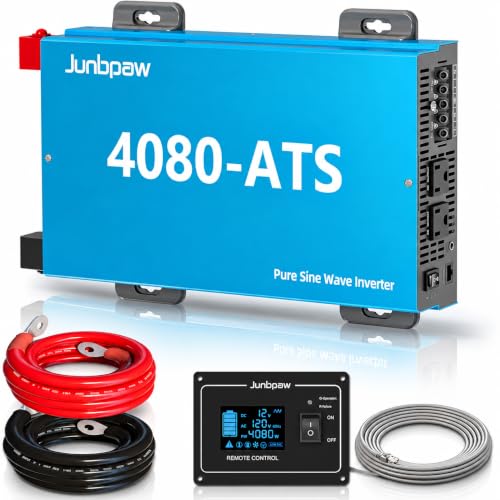
- 3500W continuous and 7000W surge output
- Pure sine wave with under 3% THD
- Built-in ATS transfers in under 20 ms
Best For: RV backup and off-grid systems needing clean, high-output power
Best Outlet Flexibility
LVYUAN 5000W Heavy-Duty Inverter
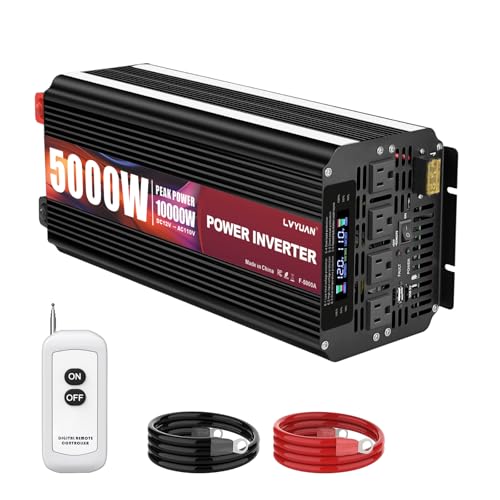
- 5000W continuous and 10000W peak output
- Four AC outlets plus hardwire connection
- LCD, wireless remote, and smart cooling
Best For: Large RVs and vehicle systems needing multiple outlets
Best Balanced Pure Sine Option

- 3000W continuous and 6000W peak output
- Pure sine wave power with over 91% efficiency
- Three AC outlets, USB, USB-C PD, and remote
Best For: RV travelers needing clean power and flexible device charging
High-Capacity Choice
Giandel 3000W Pure Sine Wave Inverter
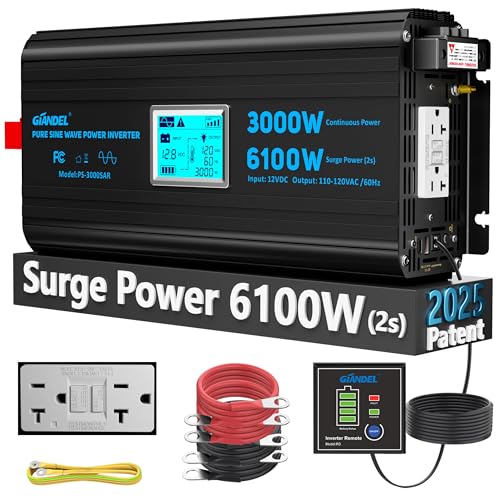
- 3000W continuous and 6100W surge output
- Selectable battery settings and LCD monitoring
- 30-foot remote plus GFCI outlets
Best For: High-demand RV and off-grid power systems
Compact Midrange Pick
BELTTT 1000W Pure Sine Wave Inverter

- 1000W continuous and 2000W peak output
- Two AC outlets plus USB charging
- LCD status display and six protection functions
Best For: Moderate RV electronics and everyday charging
Feature-Rich RV Option
Vansdon 2000W Pure Sine Wave Inverter

- 2000W continuous and 4000W surge output
- Three AC outlets plus 30W USB-C PD
- 22.9-foot remote with LCD monitoring
Best For: Multi-device RV setups needing remote control
Best Pure-Sine Value – BELTTT 2000W Pure Sine Wave Inverter
For RV owners who want clean, utility-like power without stepping up to a very large inverter, the BELTTT 2000W is a well-rounded option. Its pure sine wave output suits sensitive electronics, while the LCD, remote, USB port, and hardwire connection make it practical for a range of RV and off-grid setups.
Best For: RV travelers running sensitive electronics, entertainment equipment, and moderate AC loads from a 12V battery system.
Pros:
- Pure sine wave output is suitable for sensitive and inductive loads.
- Provides 2,000W continuous power and 4,000W peak surge capacity.
- Includes an LCD, dual AC sockets, USB charging, hardwire port, and 23-foot remote.
- Offers multiple protections, including overload, overheating, and reverse-connection protection.
Cons:
- Its 2,000W continuous rating may not cover larger RV appliances or several high-draw loads at once.
- It requires a suitable 12V battery setup and appropriate installation.
The BELTTT stands out among power inverters for RVs when clean output and convenient monitoring matter more than maximum wattage. Its combination of pure sine wave power and flexible controls makes it a strong everyday choice for moderate loads.
Best High-Output Modified-Sine Option – ROARBATT 3000W RV Inverter
The ROARBATT 3000W provides substantial 12V-to-110/120V output in a compact package. For shoppers comparing power inverters for RVs, its 3,000W continuous rating, LCD monitoring, dual cooling fans, and support for several 12V battery types make it suited to demanding travel and backup use.
Best For: RV owners, truck users, and campers who need high continuous wattage for essential appliances and electronics.
Pros:
- Delivers 3,000W continuous power with 6,000W peak capacity.
- LCD displays input voltage, output voltage, and protection status.
- Compatible with LiFePO4, AGM, GEL, and lead-acid 12V batteries.
- Compact housing and included 5AWG cables simplify transport and installation.
Cons:
- Modified sine wave output may be less suitable than pure sine wave power for some sensitive or motor-driven equipment.
- It has two AC outlets and one USB port, offering fewer charging connections than some alternatives.
This ROARBATT is a practical choice when high output and portability take priority. Buyers should verify that their RV appliances are compatible with modified sine wave power before relying on it for a complete setup.
Best Heavy-Duty Pure Sine Wave – ZETAWALE 4000W RV Inverter
The ZETAWALE 4000W is built for RV electrical systems that need serious capacity. It combines 4,000W continuous output, 8,000W surge capability, pure sine wave power, four AC outlets, Type-C charging, and terminal blocks for higher-current connections.
Best For: Large RVs, mobile workshops, and off-grid users running multiple or high-demand appliances from a 12V battery bank.
Pros:
- Offers 4,000W continuous and 8,000W peak output for substantial startup loads.
- Pure sine wave power is appropriate for demanding appliances and sensitive devices.
- Includes four AC outlets, USB, Type-C, and heavy-duty AC terminal blocks.
- Long wired remote monitors battery voltage, AC output, and load wattage.
Cons:
- Its high power capability demands careful battery, cabling, and installation planning.
- At 12.8 pounds, it is heavier than lower-output options.
Among power inverters for RVs, the ZETAWALE is the strongest fit here for users who need both clean power and high capacity. Its output flexibility is valuable, but the supporting 12V battery system must be sized appropriately for the intended loads.
Best Outlet Variety – Cantonape 3000W RV Power Inverter
The Cantonape 3000W focuses on connection flexibility for RV and vehicle use. Its modified sine wave output is paired with four AC outlets, four USB ports, an LCD display, and a remote control, giving travelers plenty of ways to power smaller electronics and accessories.
Best For: RV campers who want multiple outlets for laptops, fans, game consoles, TVs, chargers, and similar devices.
Pros:
- Provides 3,000W continuous power and 6,000W surge capacity.
- Four AC outlets and four USB ports support several devices at once.
- LCD reports voltage, battery capacity, load, frequency, and fault codes.
- Includes a remote control and multiple protections against electrical faults.
Cons:
- Modified sine wave output may not be ideal for every sensitive electronic device or appliance.
- The remote requires a 12V 23A battery, which is not included.
- Four outlets may be unnecessary for users with simpler power needs.
The Cantonape is a sensible pick when outlet count and easy status checking are central to your RV setup. Its modified sine wave design makes compatibility checking important, but the generous connection options add everyday convenience.
Best High-Output Pick – 3500W Pure Sine Wave ATS Inverter
For RV owners comparing power inverters for RVs, this 3500W pure sine wave model stands out when clean power and automatic transfer switching matter. It provides 3,500W continuously, up to 7,000W for startup loads, and switches from utility power to battery power in under 20 milliseconds.
Best For: RVs, off-grid systems, and backup setups that need high output, sensitive-electronics compatibility, and an integrated ATS.
Pros:
- Pure sine wave output with less than 3% THD for electronics such as laptops, TVs, and refrigerators.
- 3500W continuous output and 7000W surge capacity for demanding appliances and tools.
- Built-in ATS, LCD remote control, low idle draw, and temperature-controlled cooling.
Cons:
- Its high-power design requires suitable 12V battery capacity and wiring.
- It has only two AC outlets.
This is a strong choice for an RV electrical system where dependable waveform quality and seamless backup transfer are more important than having numerous outlets.
Best Outlet Flexibility – LVYUAN 5000W Heavy-Duty Inverter
This LVYUAN unit is one of the more powerful power inverters for RVs, offering 5,000W continuous output and 10,000W peak capacity from a 12V battery system. Four AC outlets, a hardwire terminal, an LCD, and wireless remote control make it practical for larger RV, vehicle, and off-grid installations.
Best For: RVs, trucks, and off-grid setups that need multiple AC connections and substantial short-term surge capacity.
Pros:
- 5000W continuous and 10000W peak output for high-load equipment.
- Four AC outlets plus a hardwire terminal support several connection types.
- LCD monitoring, wireless remote control, smart cooling, and multiple safety protections.
Cons:
- Uses modified sine wave output rather than pure sine wave.
- The included remote requires a separate 12V 23A battery.
- A 12V, 5000W system can demand substantial battery and cable capacity.
Choose this model when outlet count and maximum rated output are priorities. For especially sensitive electronics, its modified sine wave specification deserves careful consideration.
Best Balanced Pure Sine Option – LANDERPOW 3000W RV Inverter
For shoppers seeking power inverters for RVs with clean output and convenient controls, the LANDERPOW 3000W model combines 3,000W continuous power with 6,000W peak capacity. Its pure sine wave output, multiple charging ports, hardwired terminal, and long-range LED remote suit RV travel, job sites, and emergency use.
Best For: RV owners who want pure sine wave power for sensitive electronics alongside flexible AC, USB, and USB-C charging.
Pros:
- Pure sine wave output and over 91% conversion efficiency support electronics and inductive loads.
- Three AC outlets, one hardwired terminal, USB ports, and a 30W PD port provide versatile connections.
- Includes heavy-duty 1 AWG copper cables, a 15-foot LED remote, and multiple protective shutdowns.
Cons:
- Its 3000W rating is lower than the 3500W and 5000W alternatives.
- The supplied details do not specify an automatic transfer switch.
- High-power operation still requires appropriately sized 12V batteries and cabling.
This model offers a practical middle ground for RVs: clean power for sensitive devices, useful charging ports, and remote monitoring without moving to the largest output class.
High-Capacity Choice – Giandel 3000W Pure Sine Wave Inverter
For RV owners who need substantial onboard power, this 3000W pure sine wave model converts 12V DC battery power to 120V AC. Its 6100W surge rating, selectable battery settings, LCD monitoring, and wired remote make it a strong option for demanding RV and off-grid setups.
Best For: RVs running higher-draw appliances, pumps, freezers, or other equipment within the inverter’s capacity.
Pros:
- 3000W continuous output with 6100W surge power for starting inductive loads.
- Pure sine wave output is suitable for sensitive electronics and appliances.
- LCD, 30-foot wired remote, GFCI outlets, and multiple protection features support convenient operation.
- Adjustable input settings support AGM, lead-acid, deep-cycle, lithium, and LiFePO4 batteries.
Cons:
- A 12V system delivering 3000W can require substantial battery and cabling capacity.
- Its higher output may be more than needed for light-duty RV electronics.
This is the most capable option in the group for buyers prioritizing continuous wattage and surge headroom. Confirm your battery bank, wiring, ventilation, and appliance startup requirements before installation.
Compact Midrange Pick – BELTTT 1000W Pure Sine Wave Inverter
This BELTTT model is a practical choice for RV owners seeking moderate power in a compact package. It provides 1000W continuously and up to 2000W for startup loads, with pure sine wave output, dual AC outlets, USB charging, and an LCD display.
Best For: RV travelers powering televisions, home-theater equipment, laptops, chargers, and other moderate loads.
Pros:
- Pure sine wave output is designed for sensitive and inductive equipment.
- Dual AC outlets, a 5V/2.1A USB port, and included battery cables add convenience.
- LCD shows input and output voltage, battery status, load status, and operating conditions.
- Built-in protection covers undervoltage, overvoltage, overload, overheating, short circuits, and reverse connection.
Cons:
- 1000W continuous output is not intended for the largest RV appliances or sustained heavy loads.
- The included remote-control functionality is not listed among the supplied features.
With its smaller footprint and useful connection options, this inverter suits everyday RV electronics without stepping up to a larger high-current model. Match the 1000W continuous rating to your expected load rather than relying on the 2000W peak figure.
Feature-Rich RV Option – Vansdon 2000W Pure Sine Wave Inverter
The Vansdon 2000W inverter balances substantial output with RV-friendly connectivity. It converts 12V DC to 110/120V AC, adds three AC outlets, USB-C PD charging, a hardwired terminal, and a long-range wired remote with LCD monitoring.
Best For: RV users who want to run several devices while monitoring battery voltage and output from a distance.
Pros:
- 2000W continuous output and 4000W surge capacity support larger startup loads.
- Three AC outlets, a hardwired terminal, USB, and 30W USB-C PD provide versatile connections.
- Pure sine wave output with stated 3%–4% THD is designed for sensitive electronics.
- 22.9-foot wired remote displays battery voltage, power output, and error codes.
Cons:
- At 2000W on a 12V system, installation requires appropriately sized batteries and wiring.
- The hardwired terminal may require more involved installation than plug-in connections.
This model stands out among these power inverters for RVs when outlet count, remote monitoring, and USB-C charging matter alongside output capacity. Its dual-fan cooling and layered protection are useful features for heavier use, but loads should still remain within the continuous rating.
How We Picked the Best Power Inverters for Rvs
We compared these 10 models by continuous wattage, surge capacity, waveform, outlet and control features, installation flexibility, and suitability for RV, vehicle, solar, and off-grid use. Pure sine wave units receive special consideration because they generally provide cleaner power for sensitive electronics, appliances, chargers, and medical equipment.
Rated output matters more than headline peak wattage. We focused on the balance between usable continuous power and short-term starting capacity, while also considering practical features such as LCD displays, wired or wireless remotes, multiple AC outlets, and automatic transfer switching.
Quick Comparison
- 1,000-watt class: Best for lights, laptops, chargers, televisions, and other modest loads.
- 2,000-watt class: A versatile choice for many RV owners running kitchen appliances and entertainment equipment selectively.
- 3,000-watt class: Better suited to larger loads, including microwaves, coffee makers, and some power tools, provided the battery system can support them.
- 4,000 watts and above: Designed for high-demand installations, larger battery banks, and users who need more simultaneous capacity.
Key Buying Factors for Power Inverters for Rvs
Continuous and Surge Wattage
Add the running wattage of the devices you expect to use at the same time, then account for startup surges from compressors, pumps, refrigerators, and motors. Choose continuous capacity above your normal total and verify that the surge rating supports the most demanding startup load.
Pure Sine Wave Output
Pure sine wave output is the safer, more broadly compatible option for modern electronics and appliances. Modified sine wave inverters may cost less, but they can cause noise, excess heat, reduced performance, or compatibility issues with certain equipment.
Battery and Installation Requirements
High-power inverters draw substantial current. A 3,000-watt load on a 12-volt system can require roughly 250 amps before losses, so use adequately sized batteries, short heavy-gauge cables, proper fusing, and sufficient ventilation. Confirm the inverter’s DC voltage matches your battery bank.
Controls, Outlets, and Transfer Features
An LCD screen can simplify monitoring input voltage, output power, and fault conditions. Remote controls are useful when the inverter is installed in a compartment. An automatic transfer switch can make shore-power and inverter-power changes more convenient, but confirm compatibility with your RV’s electrical system before installation.
Who Should Buy Which Power Inverters for Rvs?
Choose a 1,000-watt model if you mainly need portable power for electronics and light-duty loads. Choose a 2,000-watt model for a balanced setup that handles common RV conveniences without demanding an oversized battery bank. Choose a 3,000-watt model if you regularly use high-draw appliances, but plan the battery, cabling, and charging system accordingly. Choose a 4,000-watt-or-higher unit for larger rigs or demanding off-grid systems where simultaneous loads justify the added installation complexity.
Before buying, check the manufacturer’s specifications, outlet style, protection features, cooling requirements, and installation instructions. An inverter is only as capable as the battery bank and wiring supporting it.