Adding a second or third display can make a laptop workspace more productive without requiring a permanent desk setup. The models in this roundup are designed for travel, remote work, multitasking, and presentations.
Before choosing, check your laptop’s screen size, available ports, operating-system support, power requirements, and the amount of extra weight you are willing to carry.
Best 10 Laptop Screen Extenders for Dual Monitor Setups Picks for 2026
Best Ultra-Portable Pick
14.2-inch FHD Laptop Screen Extender

- 1.87-pound, 0.27-inch-thick portable design
- 1080p IPS display with 300-nit brightness
- USB-C or HDMI plug-and-play connectivity
Best For: Traveling professionals and remote workers with 14- to 17.3-inch laptops
Best Versatile Portable Monitor

- 15.6-inch 1080p IPS display with HDR
- Multiple display modes for work and gaming
- Smart cover doubles as a protective stand
Best For: Users wanting a portable monitor for laptops, phones, and consoles
Best Flexible-Viewing Pick
Funhill 14.1-inch Dual Screen Extender

- 1080p IPS display with 280-degree rotation
- Supports USB-C and HDMI connections
- Includes cables and adapters for setup
Best For: Travelers and professionals who need adjustable portrait or landscape viewing
Best Triple-Screen Upgrade

- Adds two 16-inch displays for a triple-screen setup
- 1920×1200 resolution with extra vertical space
- Slim aluminum build with 350-nit IPS screens
Best For: Power users who need expansive workspace for coding, trading, or spreadsheets
Best Scratch-Safe Design
APILDELLA 14-Inch Dual Screen Extender

- Zero-contact frame helps protect the laptop screen
- 1080p display with extended and mirrored modes
- Fits 13- to 16-inch laptops and folds 0-225°
Best For: Traveling professionals wanting a protective, adjustable second screen
Simple-Cable Productivity Pick
ZUMWALT P7 15.6-inch FHD Extender
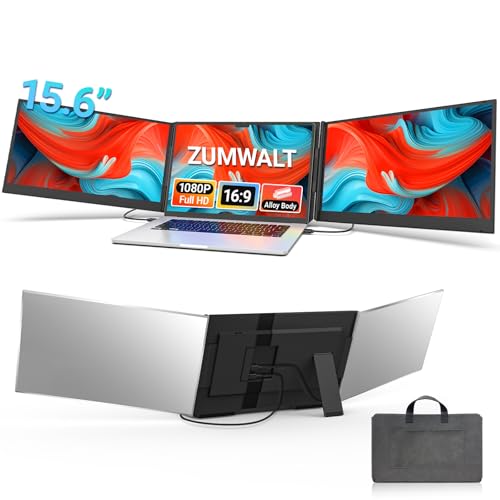
- Two 15.6-inch 1080p displays
- Uses two USB-C cables on compatible laptops
- Aluminum shell with carry bag and multiple display modes
Best For: Mobile professionals prioritizing a streamlined setup
Best Ultra-Portable Pick – 14.2-inch FHD Laptop Screen Extender
For shoppers comparing laptop screen extenders for dual monitor setups, this 14.2-inch model emphasizes portability without giving up a Full HD IPS display. It supports extended, mirrored, and portrait modes, and connects through USB-C or HDMI with the included cables.
Best For: Frequent travelers, remote workers, students, and anyone using a 14- to 17.3-inch laptop.
Pros:
- Lightweight 1.87-pound, 0.27-inch-thick design
- 1080p IPS display with 300-nit brightness
- Supports extend, mirror, and portrait viewing modes
- No-driver setup with USB-C, HDMI, and USB-A connection options
Cons:
- USB-C connection requires a full-function USB-C port
- Designed for laptops measuring 14 to 17.3 inches
This is a practical choice when portability is a priority. Its included cables, broad operating-system compatibility, adjustable viewing angle, and stated one-year warranty make it well suited to mobile productivity.
Best Versatile Portable Monitor – MNN 15.6-inch FHD Monitor
This MNN monitor is a flexible option for laptop screen extenders for dual monitor setups, with a 15.6-inch 1080p screen, multiple display modes, and support for laptops, phones, consoles, and other compatible devices. Its included cover also serves as a stand for travel or desk use.
Best For: Travelers, students, gamers, and users who want one portable screen for work and entertainment.
Pros:
- 15.6-inch Full HD IPS display with a 178-degree viewing angle
- Supports extended, duplicate, second-screen, and portrait modes
- Two full-featured USB-C ports for single-cable signal and power connections
- Includes a protective smart cover that doubles as a stand
Cons:
- USB-C setup requires a device with Thunderbolt 3 or USB 3.1 Type-C DP Alt Mode
- Glossy screen may be less suitable for bright environments
With HDR support, FreeSync, a 5ms response time, and compatibility with devices such as phones, consoles, and Macs, this model offers more flexibility than a laptop-only extender. Check your device’s USB-C video compatibility before buying.
Best Flexible-Viewing Pick – Funhill 14.1-inch Dual Screen Extender
For laptop screen extenders for dual monitor setups, the Funhill combines a compact 14.1-inch 1080p IPS panel with a 0- to 280-degree rotation range. It offers driver-free USB-C or HDMI connectivity and includes the cables and adapters needed for either connection method.
Best For: Remote workers, programmers, traders, and travelers who value flexible screen positioning.
Pros:
- 1080p IPS display with a 60Hz refresh rate
- Wide 0- to 280-degree rotation range
- Supports extended, duplicate, and portrait modes
- Includes USB-C, USB-A, HDMI, and Mini-HDMI connection accessories
Cons:
- USB-C requires full-featured USB-C with DP or Thunderbolt support
- HDMI connection needs a separate USB cable for power
- Users may need to troubleshoot power and cable connections if the screen is blank
The Funhill is a good fit when viewing flexibility and connection options matter. Its broad device and operating-system compatibility is useful, but buyers should verify USB-C specifications and plan for an extra power cable when using HDMI.
Best Triple-Screen Upgrade – 16-inch 1200p Laptop Extender
This dual-panel extender is designed for shoppers seeking laptop screen extenders for dual monitor setups that can create a three-screen workstation. Its two 16-inch 1920×1200 IPS displays provide a 16:10 workspace with extra vertical room for documents, spreadsheets, code, and web pages.
Best For: Professionals, traders, programmers, content creators, and remote workers who need maximum portable screen space.
Pros:
- Creates a triple-screen workstation with two additional displays
- 1920×1200 resolution and 16:10 aspect ratio provide extra vertical space
- 350-nit IPS displays with 178-degree viewing angles
- Ultra-slim aluminum construction with built-in speakers and eye-care features
Cons:
- Requires two full-featured USB-C ports on the laptop
- At 4.6 pounds, it is heavier than the single-screen options
- Uses two USB-C cables for setup
This is the strongest productivity-oriented option in the group for users who genuinely need three screens. Its larger displays and 16:10 resolution are useful for dense work, but the weight and dual-port requirement make it less convenient for casual travel.
Best Lightweight FHD Pick – 14-Inch Portable Laptop Screen Extender
For shoppers comparing laptop screen extenders for dual monitor setups, this 14-inch DZVW model offers a compact way to add a second workspace. Its 1080p IPS display supports extended, mirrored, and portrait viewing, while USB-C and HDMI connectivity make it practical for office work, travel, and entertainment.
Best For: Remote workers and travelers who want a lightweight, portable second screen with flexible viewing modes.
Pros:
- 14-inch 1920×1080 IPS display with 60Hz refresh rate, 300-nit brightness, and matte finish.
- Supports extended, mirrored, and portrait modes.
- Foldable design weighs about 2.3 pounds and is approximately 0.9 inches thick when folded.
- Includes USB-C, HDMI, and USB-A-related cables for driver-free setup.
Cons:
- HDMI use requires an additional USB-A-to-USB-C connection for power.
- Compatibility depends on having a full-featured USB-C or HDMI port; some Surface Pro devices may not work.
This model is a sensible choice when portability matters as much as screen space. Confirm your laptop’s ports before buying, especially if you plan to use HDMI.
Best Triple-Screen Flexibility – 15.6-Inch Detachable Laptop Extender
This 15.6-inch extender stands out among laptop screen extenders for dual monitor setups because it can also support a triple-screen arrangement. Its detachable panels, broad rotation range, and landscape, portrait, or stacked configurations make it useful for multitasking, presentations, and collaborative viewing.
Best For: Power users who want a larger triple-screen setup and the option to use the displays separately.
Pros:
- Two 15.6-inch 1080p displays can create a triple-screen laptop setup or be used independently.
- Supports 235° horizontal rotation, 90° vertical rotation, portrait, landscape, and stacked configurations.
- IPS panels include anti-glare, flicker-free, low-blue-light features, and built-in speakers.
- Supports USB-C, USB-A, and HDMI connections without requiring drivers.
Cons:
- Compatibility is limited with Apple M1, M2, and M3 chips according to the supplied notes; M1/M2/M3 Pro and Max models are listed as supported.
- HDMI connections require an additional USB-A-to-USB-C cable for power.
- The larger dual-panel design is less compact than a single-screen extender.
If maximum workspace and adjustability are priorities, this is the most versatile option in the group. Check your laptop’s processor, ports, and available space before choosing it.
Best Scratch-Safe Design – APILDELLA 14-Inch Dual Screen Extender
For a straightforward addition to dual monitor setups, the APILDELLA A4 combines a 14-inch 1080p display with a zero-contact frame intended to help protect the laptop screen from scratches. Its sliding support arm fits 13- to 16-inch laptops, and plug-and-play connections simplify use at home, in the office, or while traveling.
Best For: Laptop users who want a compact second monitor with adjustable positioning and a protective mounting design.
Pros:
- 14-inch 1920×1080 display supports extended and mirrored modes.
- Zero-contact frame is designed to help prevent scratches, with a sliding arm for 13- to 16-inch laptops.
- Foldable through a 0-225° range for adjustable positioning.
- Includes USB-C, USB-A, and HDMI cables and requires no driver installation.
Cons:
- At 250 cd/m², its listed brightness is lower than some competing models in this roundup.
- HDMI setups may require external power and specific cable configurations.
- Users may need to troubleshoot cable combinations if the display shows no signal or insufficient brightness.
This extender is a practical fit for routine productivity tasks, especially if screen protection and simple positioning are important. Follow the recommended connection configurations to get adequate power and signal.
Ultra-Slim Triple-Screen Pick – Macsecor 14-inch FHD Laptop Screen Extender
For shoppers comparing laptop screen extenders for dual monitor setups, the Macsecor stands out with two 14-inch FHD displays, a slim clamp-on design, and support for laptops from 13 to 17.3 inches. Its dual-line connection design aims to simplify setup while supporting extended, mirrored, portrait, and landscape modes.
Best For: Professionals, programmers, stock traders, and travelers who want a lightweight triple-screen workstation.
Pros:
- Two 14-inch 1080p IPS displays with HDR, blue-light filtering, and anti-glare technology.
- Ultra-slim 0.27-inch screens and a built-in aluminum stand with up to 90-degree adjustment.
- Supports Windows, macOS, Chrome OS, Android, and Linux, with a one-year replacement warranty.
- Offers extended, mirrored, portrait, and landscape viewing modes.
Cons:
- M1/M2/M3 MacBooks or laptops without full-featured USB-C may require an additional H5-T cable.
- The 3-pound design is portable but still adds noticeable weight to a laptop bag.
The Macsecor is a practical choice when portability and flexible viewing modes matter more than having the largest possible panels. Check your laptop’s USB-C and HDMI capabilities before ordering.
Large-Panel Travel Pick – KEFEYA 15.6-inch FHD Triple Monitor
The KEFEYA is a strong option among laptop screen extenders for dual monitor setups if you prefer larger 15.6-inch panels. It combines two FHD IPS displays with adjustable picture settings, multiple viewing modes, and a foldable design with a leather carrying bag.
Best For: Remote workers, travelers, and multitaskers who want larger screens for work, video calls, entertainment, or coding.
Pros:
- Two 15.6-inch 1080p IPS displays with 178-degree viewing angles.
- Matte screens, low-blue-light support, and independently adjustable display settings.
- Foldable design, 180-degree rotation, and included leather carrying bag.
- Includes USB-C and HDMI connection cables for flexible setups.
Cons:
- At roughly 3.9 to 4 pounds, it is heavier than smaller portable extenders.
- USB-A to USB-C connection supports power supply only.
- Macs with M1, M2, or M3 chips require the separately sold H6 adapter.
Choose the KEFEYA when screen size and adjustable viewing are priorities. Its broader panel area is useful for side-by-side work, but confirm your laptop’s ports and account for the extra travel weight.
Simple-Cable Productivity Pick – ZUMWALT P7 15.6-inch FHD Extender
For buyers seeking laptop screen extenders for dual monitor setups with fewer cables, the ZUMWALT P7 uses two USB-C to USB-C cables when the laptop supports full functionality. Its two 15.6-inch FHD screens, aluminum shell, and included travel accessories make it suited to mobile multitasking.
Best For: On-the-go professionals who want a larger triple-screen workspace with a streamlined setup.
Pros:
- Two 15.6-inch 1080p displays with 280-nit brightness and 178-degree viewing angles.
- Can connect with only two USB-C cables on compatible laptops.
- Aluminum alloy shell, included leather carry bag, and approximately 4-pound weight.
- Supports extended, mirrored, and portrait display modes.
Cons:
- Laptops without full-featured USB-C and M1/M2/M3 MacBooks need an additional H5-T cable.
- Alternative H5-T connections may require HDMI, USB-A power, and driver installation.
- The glossy finish may be less suitable for bright or reflective environments.
The ZUMWALT P7 is appealing for users who want a clean, cable-minimized connection and larger screens. Compatibility is more dependent on the laptop’s USB-C capabilities, so verify those ports before purchase.
How We Picked the Best Laptop Screen Extenders for Dual Monitor Setups
We compared these Laptop Screen Extenders for Dual Monitor Setups by focusing on the features that most affect daily usability: display size and resolution, laptop-size compatibility, connection options, portability, installation, adjustability, and power demands. We also considered whether each design adds one display or supports a triple-screen arrangement.
Product descriptions identify several common configurations, including 14-inch and 15.6-inch panels, Full HD resolution, USB-C and HDMI connectivity, detachable designs, rotating hinges, and ultra-slim construction. Because port layouts and operating-system support can vary by model, verify the manufacturer’s specifications before ordering.
Quick Comparison
| Feature | What to look for | Best suited to |
|---|---|---|
| Screen size | Approximately 14 to 15.6 inches | Matching common laptop displays and maximizing workspace |
| Resolution | 1080p Full HD or higher | Text, spreadsheets, browsing, and video |
| Configuration | Single extender or dual-panel triple-screen design | Moderate multitasking or maximum workspace |
| Connectivity | USB-C, HDMI, and required USB power | Simple setup across different laptops |
| Portability | Thin construction, detachable panels, and manageable weight | Commuting, travel, and flexible workspaces |
Key Buying Factors for Laptop Screen Extenders for Dual Monitor Setups
Compatibility and Ports
Start with the laptop’s display size and supported mounting range. Many extenders fit laptops from roughly 13 to 17.3 inches, but a close physical fit does not guarantee electronic compatibility. USB-C must support video output when used as a display connection; some USB-C ports provide only charging or data. HDMI models may need a separate USB cable for power.
Display Quality and Layout
1080p is generally sufficient for office work, communication, web browsing, and media. A higher-resolution or 1200p panel may provide additional vertical space, while a 15.6-inch display can make documents easier to read. Consider viewing angles, brightness, refresh rate, and whether the screen can rotate or detach.
Weight, Thickness, and Power
Portable monitors add weight to a laptop bag and may draw power from the computer or a wall adapter. Ultra-slim models are easier to carry, but triple-screen systems can be heavier and more demanding. Confirm the included cables and whether your laptop can supply enough power during extended use.
Operating-System and Software Support
Plug-and-play claims vary. Some setups work directly through USB-C or HDMI, while others require drivers or an adapter. Check support for Windows, macOS, ChromeOS, and your laptop’s graphics hardware before buying, especially if you plan to use multiple external displays.
Who Should Buy Which Laptop Screen Extenders for Dual Monitor Setups?
Choose a lightweight 14-inch extender if you travel frequently or want a balanced second screen for documents and communication. A 15.6-inch model is better when readability and workspace matter more than compact packing. Select a triple-screen extender if you regularly compare spreadsheets, code, research, or timelines across multiple applications. Detachable or rotating designs suit users who need flexible positioning, while straightforward USB-C or HDMI models are preferable for quick setup and fewer adjustments.